Posts

Showing posts with the label Nebulae

First Mosaics

Image
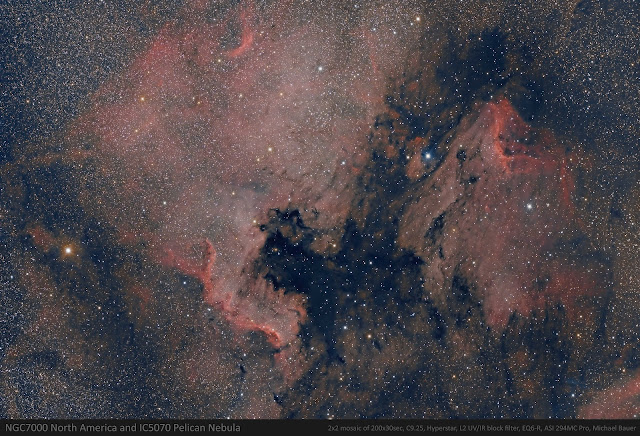
The comparably short focal length of 525mm provided by the Hyperstar is giving a quite big field of view enabling the fast imaging of objects that are simply too big for the optics I was using before. The C9.25 has a focal length of 1480mm with reducer and 2350mm at primary focus. This is good for smaller objects like most galaxies, but most of the objects I showed in the previous posts simply wouldn't fit in one picture.  I was eager to take picture of all the big objects that I always took off the list before. However, as it turns out, there are still a number of "famous" objects that won't fit in a single image even with the Hyperstar. So, I did bite the bullet and started composing mosaics of multiple images. It turns out that this works quite well, even though the required exposure times grow quite fast with the number of mosaic panels. Here is a first 2x2 mosaic I did of the North America and Pelican Nebula. Each subimage is an integration of 200 frames. My seco...

Hyperstar Nebula Harvest

Image
Last week we had two clear nights. Even though it still was some 25-20% waning moon I decided to image full RGB spectrum - without the narrowband filter.  Many experienced astrophotographers will concentrate on the same object over multiple nights to gather data for very deep images. However, somehow I have not developed that level of maturity yet. I wanted to play and to see what my new Hyperstar optics is able to do. So, I took pictures of a number of nebulae to get a better sense of what could be nice targets for the future. As I had already taken a picture of the "Heart Nebula" I added the nearby "Soul Nebula" as well: The Elephant trunk nebula is a pretty big (and beautiful) object. This is my first image of it. I noticed that the actual "trunk" is relatively small, so it may be worth imaging at a longer focal length. The Cave Nebula an interesting object with many dark nebulosity - fits quite nicely in the Hyperstar frame. The Bubble Nebula is actual...

Hyperstar first Light - Part 2 Narrowband Imaging

Image
One of the main open questions when buying a Hyperstar was how it would work with L-eXtreme dual narrowband filter. At f/2.2 the light will no longer be mostly parallel to the optical axis,but will pass the filter at comparably high angles. This will lead to a downward shift in the filter transmission wavelengths. There are filters that are specifically designed to compensate, others just have wider transmission windows to be less sensitive for that effect. However, as these filters aren’t cheap, I wanted to see what I can do with my L-eXxtreme first. Results published by other amateur astronomers vary from "the filter is completely useless at f/2" to "among my many filters the L-eXtreme is the best with my Hyperstar". Apparently, there is a bit of variability in the spectral transmission curve between the individual filter specimens. In my second night of testing the Hyperstar I therefore took a number of images using the filter. As there was rain forecasted in the...

Hyperstar first Light - Part 1 Setup and first Pictures

Image
One of the first images taken with my new Hyperstar.  After long deliberation I bought a Hyperstar system for my C9.25 Schmidt Cassegrain. For quite a while I was torn between the Hyperstar and getting a separate refractor. I did a lot of research and in the end I changed my opinion almost on a daily basis. Finally, I decided that the pros and cons of these two approaches are probably reasonably balanced and that I need to try it myself.   If you are not familiar with it - the Hyperstar is an optical system that is put in place of the secondary mirror of a Celestron Schmidt Cassegrain telescope, basically turning it into a very fast astrograph. For example, C9.25 becomes an f/2.2 system with 525mm focal length. The Hyperstar mounted on top of the telescope  Rough Collimation One of the drawbacks of a system like the Hyperstar is that, like all reflector telescopes, it requires some level of alignment i.e collimation of the optical components in order to perform optimally....

Unfiltered Nebulae and the need for Star Reduction

Image
Moonless nights are great for imaging without the filter. While I enjoy using my narrowband filter to capture images of faint nebulae, not all objects are really suitable for it and sometimes I just like the unfiltered view.     Therefore I try to take unfiltered pictures whenever the conditions are right.   The other week I took a number of pictures of nebulae at full C9 focal length of 2350mm. As the objects were within or close to the plane of the Milky Way the pictures had many stars that were quite a distraction from the main object. This hardly a problem when using a narrowband filter, as only a small percentage of the star light is getting through. In unfiltered images number, brightness and size of stars can become an issue. Conditions were probably not perfect, increasing the problem. However, at these long focal lengths the effect is hard to avoid entirely.  One can address this in image processing by various star reduction algorithms. I took a quick crash ...

Moon Nights / Nebula Nights

Image
In clear nights that have quite a bit of moonlight I like to take my dual narrowband filter out for a spin. Last week we had a couple of such nights, so a perfect opportunity to gather some data on a few of the summer sky nebula.  Normally I am using a process called HDR multiscale transformation to get a good balance between the bright and the fainter parts of an object. However, in the case of M27 this would have reduced the color of the inner part of the nebula way too much. I went with soft masks for the inner regions instead and stretched these parts manually.   There are still some issues with the images I need to try addressing - e.g. the amplifier glow is not fully corrected, and I partially have a reddish tint. However, overall I am optimistic and think that the pictures are quite pretty and are showing a lot of detail. 

Taking care of the Leftovers

Image
Where I live the nights in June are super short, if it is fully getting dark at all. So this is a good time to look at some of the raw images collected earlier in the year before I was fully consumed by the Galaxy-Fever.  For various reasons I never fully processed these pictures. On some of the objects I wanted to take more raw frames and some were just tests for a bigger project. Well, none of that actually happened after Galaxy season started.  Looking at them now I think that they really didn’t deserve to be ignored that way. Some of them are actually quite nice and the objects deserve more attention in the future. 

RGB Composition of Dual Narrowband Images

Image
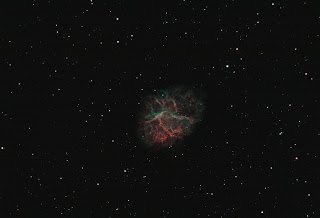
Using the L-eXtreme dual narrowband filter allows taking quite impressive pictures of various nebulae. However, it will create quite unnaturally looking star colors and will filter out features of the object that are not particularly emitting the spectral lines of Ha or OIII.   Some objects, due to their physical structure, look quite different in the narrowband than in images taken over the full RGB continuum. The crab nebula M1 is a good example for this. M1 the crab nebula in HaOIII, 40x90sec C9.25 on EQ6-R Pro, ASI294MC PRO, L-eXtreme M1 the crab nebula unfiltered RGB image, 40x60sec, C 9 .25 on EQ6-R Pro, ASI 294MC Pro It is interesting to look at and compare these pictures individually.    However, I wanted to try combining them in a meaningful way. Basically I had five different "channels" - red, green, blue, Ha and OIII and was looking for good ways to compose an image from that. There are several ways for doing that, some more flexible than others. I ended u...

First pictures with Dual Narrowband Filter - fixing the color fringe

Image
When taking my first pictures with the L-eXtrem dual narrowband filter I was quite pleased with the results I was able to get. This filter passes only the Wavelengths of the Ha and O III spectral lines that are very prominent in may nebulae. It turns out being a good tool to expand imaging time beyond just the moonless nights.  Core of M42 Orion Nebula im HaOIII, 50x10sec C9.25 on EQ6-R Pro, ASI294MC PRO, Reducer 1/6.3, L-eXtreme IC405 in HaOIII, 30x300s,  C9.25 on EQ6-R Pro, ASI294MC PRO, Reducer 1/6.3, L-eXtreme IC433 in HaOIII, 40x120sec C9.25 on EQ6-R Pro, Reducer 1/6.3, L-eXtreme Filter Detail of NGC2246, Rosette Nebula in HaOIII, 30x90sec C9.25 on EQ6-R Pro, ASI294MC PRO, Reducer 1/6.3, L-eXtreme However, I noticed that particularly the pictures that were taken with both the reducer/corrector and the filter showed some light color fringe around the stars. I assume that something in the geometry of the imaging train wasn’t quite optimal. As I didn’t have to many opti...