Posts

Showing posts with the label Editing

PixInsight - a quick update on post processing

Image
When I started with astrophotography last year I exclusively worked with free software for the post processing tasks. I mostly used SIRIL and a little bit of Gimp as tools. Some of the early results I have shared in this blog. They were ok at the time, but I knew that I wanted them to become better in the long run. So early this year, during galaxy season, I was starting to search for the software environment I would be using during my next steps. In principle the free tools can be used to produce extraordinary results much beyond what I was doing at the time. However, I felt that there may be limitations at some point and apparently most astrophotographers are switching to other tools eventually. As a result of that there is very little information available about how to use the free tools specifically in astrophotography beyond the very basic tasks.  I tested a few solutions, but eventually decided for PixInsight, apparently a pretty large number of astrophotographers are using t...
First Mosaics

Image
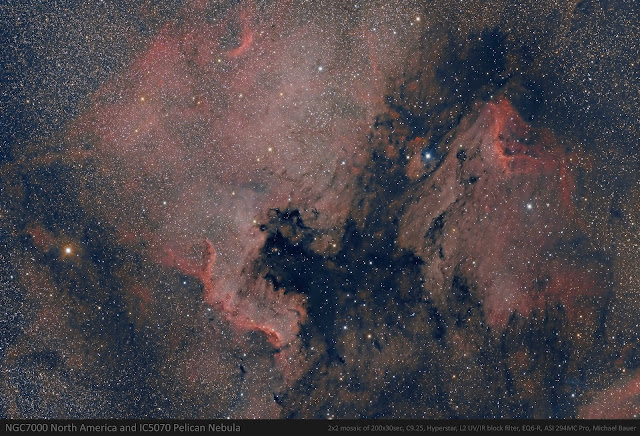
The comparably short focal length of 525mm provided by the Hyperstar is giving a quite big field of view enabling the fast imaging of objects that are simply too big for the optics I was using before. The C9.25 has a focal length of 1480mm with reducer and 2350mm at primary focus. This is good for smaller objects like most galaxies, but most of the objects I showed in the previous posts simply wouldn't fit in one picture.  I was eager to take picture of all the big objects that I always took off the list before. However, as it turns out, there are still a number of "famous" objects that won't fit in a single image even with the Hyperstar. So, I did bite the bullet and started composing mosaics of multiple images. It turns out that this works quite well, even though the required exposure times grow quite fast with the number of mosaic panels. Here is a first 2x2 mosaic I did of the North America and Pelican Nebula. Each subimage is an integration of 200 frames. My seco...

RGB Composition of Dual Narrowband Images

Image
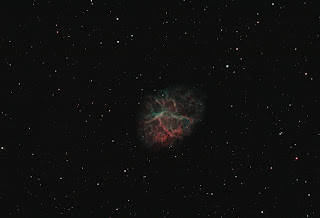
Using the L-eXtreme dual narrowband filter allows taking quite impressive pictures of various nebulae. However, it will create quite unnaturally looking star colors and will filter out features of the object that are not particularly emitting the spectral lines of Ha or OIII.   Some objects, due to their physical structure, look quite different in the narrowband than in images taken over the full RGB continuum. The crab nebula M1 is a good example for this. M1 the crab nebula in HaOIII, 40x90sec C9.25 on EQ6-R Pro, ASI294MC PRO, L-eXtreme M1 the crab nebula unfiltered RGB image, 40x60sec, C 9 .25 on EQ6-R Pro, ASI 294MC Pro It is interesting to look at and compare these pictures individually.    However, I wanted to try combining them in a meaningful way. Basically I had five different "channels" - red, green, blue, Ha and OIII and was looking for good ways to compose an image from that. There are several ways for doing that, some more flexible than others. I ended u...

First pictures with Dual Narrowband Filter - fixing the color fringe

Image
When taking my first pictures with the L-eXtrem dual narrowband filter I was quite pleased with the results I was able to get. This filter passes only the Wavelengths of the Ha and O III spectral lines that are very prominent in may nebulae. It turns out being a good tool to expand imaging time beyond just the moonless nights.  Core of M42 Orion Nebula im HaOIII, 50x10sec C9.25 on EQ6-R Pro, ASI294MC PRO, Reducer 1/6.3, L-eXtreme IC405 in HaOIII, 30x300s,  C9.25 on EQ6-R Pro, ASI294MC PRO, Reducer 1/6.3, L-eXtreme IC433 in HaOIII, 40x120sec C9.25 on EQ6-R Pro, Reducer 1/6.3, L-eXtreme Filter Detail of NGC2246, Rosette Nebula in HaOIII, 30x90sec C9.25 on EQ6-R Pro, ASI294MC PRO, Reducer 1/6.3, L-eXtreme However, I noticed that particularly the pictures that were taken with both the reducer/corrector and the filter showed some light color fringe around the stars. I assume that something in the geometry of the imaging train wasn’t quite optimal. As I didn’t have to many opti...