Posts

Showing posts with the label Narrowband

Lucky Imaging in the Clouds

Image
Weather conditions had been pretty mediocre over the last couple of weeks. In addition to the almost full moon clouds kept moving though, so a majority of the frames I took were unusable. It really felt more like "lucky imaging" than a regular session of deep sky photography. I did a more thorough analysis of the raw frames and noticed that the presence of the Moon has quite an impact on the image quality, even for narrowband pictures. However, I noticed as well that apparently the final images still are benefiting from including the frames with poor signal to noise ratio (eg. due to thin clouds moving through). In the following images I included all the frames, where the nebula was at least visible, even if they had a poor SNR. I guess this approach of imaging at almost full moon at poor weather will not be viable for fainter objects, but I think the results show that it may be still worth it for the brighter nebulae. I am never sure if I like the natural colors or the HOO p...

Hyperstar first Light - Part 2 Narrowband Imaging

Image
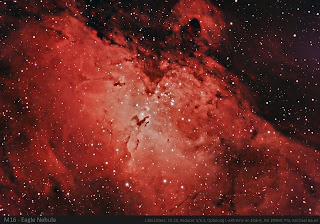
One of the main open questions when buying a Hyperstar was how it would work with L-eXtreme dual narrowband filter. At f/2.2 the light will no longer be mostly parallel to the optical axis,but will pass the filter at comparably high angles. This will lead to a downward shift in the filter transmission wavelengths. There are filters that are specifically designed to compensate, others just have wider transmission windows to be less sensitive for that effect. However, as these filters aren’t cheap, I wanted to see what I can do with my L-eXxtreme first. Results published by other amateur astronomers vary from "the filter is completely useless at f/2" to "among my many filters the L-eXtreme is the best with my Hyperstar". Apparently, there is a bit of variability in the spectral transmission curve between the individual filter specimens. In my second night of testing the Hyperstar I therefore took a number of images using the filter. As there was rain forecasted in the...

Moon Nights / Nebula Nights

Image
In clear nights that have quite a bit of moonlight I like to take my dual narrowband filter out for a spin. Last week we had a couple of such nights, so a perfect opportunity to gather some data on a few of the summer sky nebula.  Normally I am using a process called HDR multiscale transformation to get a good balance between the bright and the fainter parts of an object. However, in the case of M27 this would have reduced the color of the inner part of the nebula way too much. I went with soft masks for the inner regions instead and stretched these parts manually.   There are still some issues with the images I need to try addressing - e.g. the amplifier glow is not fully corrected, and I partially have a reddish tint. However, overall I am optimistic and think that the pictures are quite pretty and are showing a lot of detail. 

Taking care of the Leftovers

Image
Where I live the nights in June are super short, if it is fully getting dark at all. So this is a good time to look at some of the raw images collected earlier in the year before I was fully consumed by the Galaxy-Fever.  For various reasons I never fully processed these pictures. On some of the objects I wanted to take more raw frames and some were just tests for a bigger project. Well, none of that actually happened after Galaxy season started.  Looking at them now I think that they really didn’t deserve to be ignored that way. Some of them are actually quite nice and the objects deserve more attention in the future. 

Filtered Galaxies

Image
Before I started Astrophotography I visually observed several types of objects using filters. However, for galaxies I generally preferred the unfiltered view. While it sometimes may reveal individual features that are invisible without the filter, the brightness of the galaxy is reduced by a lot and I found the overall appearance quite underwhelming.   Therefore I was not quite sure what to expect when taking my first pictures with the dual narrowband filter I had been using before. However, in a clear night with an almost full moon I gave it a shot. Due to the longer exposure times required was only able to take quite few individual frames     per object, but after I stacked them they showed a number of features that are invisible on unfiltered pictures.     Most surprising to me I was the strange beauty of the galaxies in the filtered light. I had never seen them like that before. As the filtered images are enhancing a number of features (mostly H alpha) an ob...

RGB Composition of Dual Narrowband Images

Image
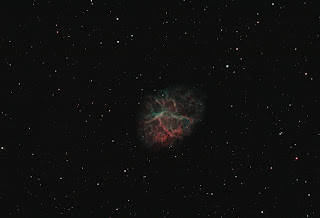
Using the L-eXtreme dual narrowband filter allows taking quite impressive pictures of various nebulae. However, it will create quite unnaturally looking star colors and will filter out features of the object that are not particularly emitting the spectral lines of Ha or OIII.   Some objects, due to their physical structure, look quite different in the narrowband than in images taken over the full RGB continuum. The crab nebula M1 is a good example for this. M1 the crab nebula in HaOIII, 40x90sec C9.25 on EQ6-R Pro, ASI294MC PRO, L-eXtreme M1 the crab nebula unfiltered RGB image, 40x60sec, C 9 .25 on EQ6-R Pro, ASI 294MC Pro It is interesting to look at and compare these pictures individually.    However, I wanted to try combining them in a meaningful way. Basically I had five different "channels" - red, green, blue, Ha and OIII and was looking for good ways to compose an image from that. There are several ways for doing that, some more flexible than others. I ended u...

First pictures with Dual Narrowband Filter - fixing the color fringe

Image
When taking my first pictures with the L-eXtrem dual narrowband filter I was quite pleased with the results I was able to get. This filter passes only the Wavelengths of the Ha and O III spectral lines that are very prominent in may nebulae. It turns out being a good tool to expand imaging time beyond just the moonless nights.  Core of M42 Orion Nebula im HaOIII, 50x10sec C9.25 on EQ6-R Pro, ASI294MC PRO, Reducer 1/6.3, L-eXtreme IC405 in HaOIII, 30x300s,  C9.25 on EQ6-R Pro, ASI294MC PRO, Reducer 1/6.3, L-eXtreme IC433 in HaOIII, 40x120sec C9.25 on EQ6-R Pro, Reducer 1/6.3, L-eXtreme Filter Detail of NGC2246, Rosette Nebula in HaOIII, 30x90sec C9.25 on EQ6-R Pro, ASI294MC PRO, Reducer 1/6.3, L-eXtreme However, I noticed that particularly the pictures that were taken with both the reducer/corrector and the filter showed some light color fringe around the stars. I assume that something in the geometry of the imaging train wasn’t quite optimal. As I didn’t have to many opti...

Deep Sky Photography at a Moonlit Night

Image
Last week we had a couple of beautiful winter days with reasonably clear nights. Unfortunately, it was almost full moon with the moon lit to 80-90%. However, with the enthusiasm that is typical for beginners I didn’t want to use the night exclusively to test equipment - I wanted to get a few pictures as well.  Star clusters are an object type that I used to observe visually at such nights as they are usually reasonably bright and have good contrast. So that ist what I try first.  NGC457, The Owl cluster 30x10sec, C9. 25 with reducer 1/6.3, ASI 294MC Pro on EQ6-R Pro M35 (right) with NGC 2158 (left) 30x10sec, C9. 25 with reducer 1/6.3, ASI 294MC Pro on EQ6-R Pro I think these came out quite nice. With so much moonlight it is hard to take longer exposures to get deeper. However, the brighter stars are starting to saturate anyhow, so these settings are probably ok. Most deep sky objects are looking way more impressive on a photograph than visually. However, while I like...