Posts

Hyperstar first Light - Part 1 Setup and first Pictures

Image
One of the first images taken with my new Hyperstar.  After long deliberation I bought a Hyperstar system for my C9.25 Schmidt Cassegrain. For quite a while I was torn between the Hyperstar and getting a separate refractor. I did a lot of research and in the end I changed my opinion almost on a daily basis. Finally, I decided that the pros and cons of these two approaches are probably reasonably balanced and that I need to try it myself.   If you are not familiar with it - the Hyperstar is an optical system that is put in place of the secondary mirror of a Celestron Schmidt Cassegrain telescope, basically turning it into a very fast astrograph. For example, C9.25 becomes an f/2.2 system with 525mm focal length. The Hyperstar mounted on top of the telescope  Rough Collimation One of the drawbacks of a system like the Hyperstar is that, like all reflector telescopes, it requires some level of alignment i.e collimation of the optical components in order to perform optimally....

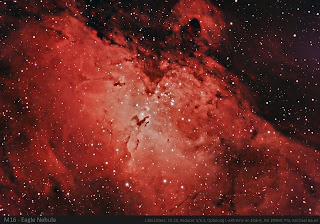
Unfiltered Nebulae and the need for Star Reduction

Image
Moonless nights are great for imaging without the filter. While I enjoy using my narrowband filter to capture images of faint nebulae, not all objects are really suitable for it and sometimes I just like the unfiltered view.     Therefore I try to take unfiltered pictures whenever the conditions are right.   The other week I took a number of pictures of nebulae at full C9 focal length of 2350mm. As the objects were within or close to the plane of the Milky Way the pictures had many stars that were quite a distraction from the main object. This hardly a problem when using a narrowband filter, as only a small percentage of the star light is getting through. In unfiltered images number, brightness and size of stars can become an issue. Conditions were probably not perfect, increasing the problem. However, at these long focal lengths the effect is hard to avoid entirely.  One can address this in image processing by various star reduction algorithms. I took a quick crash ...

Moon Nights / Nebula Nights

Image
In clear nights that have quite a bit of moonlight I like to take my dual narrowband filter out for a spin. Last week we had a couple of such nights, so a perfect opportunity to gather some data on a few of the summer sky nebula.  Normally I am using a process called HDR multiscale transformation to get a good balance between the bright and the fainter parts of an object. However, in the case of M27 this would have reduced the color of the inner part of the nebula way too much. I went with soft masks for the inner regions instead and stretched these parts manually.   There are still some issues with the images I need to try addressing - e.g. the amplifier glow is not fully corrected, and I partially have a reddish tint. However, overall I am optimistic and think that the pictures are quite pretty and are showing a lot of detail. 

Globular Cluster Nights

Image
After the galaxy frenzy of the previous months I was planning to take it a bit slower for some time. Usually I had not been observing around the summer solstice with its short and not entirely dark nights. Over many years I developed the habit of picking up visual astronomy again sometime during August. However, this year, concentrating on astrophotography, I really felt the itch to make some photos even shortly after the summer solstice.     With the short nights and moon coming up as well I didn’t feel comfortable going after some dim nebula, so I picked globular clusters as targets.  While some are at their best visibility right now, a few of them were at lower altitude, so I am not entirely satisfied with the results in all cases. However, it is still a nice collection of objects I believe. (M11 is not actually a globular cluster, but it still fits nicely in this series)

Taking care of the Leftovers

Image
Where I live the nights in June are super short, if it is fully getting dark at all. So this is a good time to look at some of the raw images collected earlier in the year before I was fully consumed by the Galaxy-Fever.  For various reasons I never fully processed these pictures. On some of the objects I wanted to take more raw frames and some were just tests for a bigger project. Well, none of that actually happened after Galaxy season started.  Looking at them now I think that they really didn’t deserve to be ignored that way. Some of them are actually quite nice and the objects deserve more attention in the future. 

Galaxies at a larger scale

Image
The primary focus of the C9.25 at 2350mm in combination with the sensor size of my ASI 294 is giving a field of view that turned out to be a nice fit for imaging most of the spring galaxies.   However, there are a number of objects that do not quite fit. So I spent a few nights end of April to image a with the 1/6.3 reducer. This is giving a slightly larger field of view. More suitable for some of the larger objects. In addition to the larger galaxies I tried some groups of galaxies. Here it was a bit harder to get a good fit. HCG 44 may actually be better without the reducer. The famous Leo triplet is too big to fit within the FOV - so I captured only two of them. I think they are beautiful - even as a pair.  For the really huge galaxies - like e.g. the Andromeda galaxy - as well as the large scale galaxy groups even shorter focal lengths would be required. I still need to find a good solution for that. In the meantime I enjoy how these medium sized objects turned out.

Filtered Galaxies

Image
Before I started Astrophotography I visually observed several types of objects using filters. However, for galaxies I generally preferred the unfiltered view. While it sometimes may reveal individual features that are invisible without the filter, the brightness of the galaxy is reduced by a lot and I found the overall appearance quite underwhelming.   Therefore I was not quite sure what to expect when taking my first pictures with the dual narrowband filter I had been using before. However, in a clear night with an almost full moon I gave it a shot. Due to the longer exposure times required was only able to take quite few individual frames     per object, but after I stacked them they showed a number of features that are invisible on unfiltered pictures.     Most surprising to me I was the strange beauty of the galaxies in the filtered light. I had never seen them like that before. As the filtered images are enhancing a number of features (mostly H alpha) an ob...

Making Progress on the Galaxies

Image
The previous images of the spring galaxies looked very promising. As a next step I hoped to improve them further by gathering more data per object and by further practicing my image processing skills. As I found it too hard to focus my attention to just one galaxy the total number of frames per object is increased only to a few hundred. On top of that I had to exclude a number of frames as the nights end of March turned out a bit hazy leading to bad contrast in the individual images. However, I find the resulting images are a good step in the right direction. In many cases a lot more detail is visible in the Galaxies.